A US Treasury Bond Trade Setup For UK Investors

If you’ve followed my recent articles, you’ll know I’ve been banging on about US Treasury bonds for some time. Specifically, long-dated US Treasury bonds that mature in 20 years or more. My general thesis is that these bonds could do well if US interest rates and inflation both drop. If you’re a UK investor (like me), here’s how to get exposure to the trade.
Why US Treasury bonds, why now?
On Tuesday, I explained how AI might cause the next economic recession. Here’s my thinking:
- AI is replacing office jobs: more people could be unemployed and have less money to spend.
- AI is making things cheaper to produce: inflation could go down from here.
When investors expect deflation (the opposite of inflation), they tend to buy long-term bonds. That’s because the fixed interest payments hold their value better when inflation isn’t eating away at them. That could be good for bond prices.
But when inflation is falling and the economy is slowing, US Treasury bonds often become a safety net. These are loans to the US government, and the US economy doesn’t default (not yet, anyway).
Long-dated bonds are highly sensitive to interest rate changes – when rates go down, bond prices tend to go up. Here’s an example to explain how the math works:
- You own a 20-year Treasury bond paying a fixed 5% coupon (interest payment) each year.
- The US central bank (Fed) then lowers interest rates to speed up the economy.
- The Government creates new Treasury bonds with lower coupon rates (since interest rates dropped).
- But your bond still pays 5%, so it becomes more attractive – and its price goes up.
- The longer your bond has left to pay coupons, the bigger the price jump if rates fall.
It’s also a classic contrarian setup. Long-dated US Treasury bonds have been hated for years. Now they’re down huge, sentiment is poor, and the upside if you’re right could be meaningful.
How US investors can buy long-dated US Treasury bonds
US investors can buy the iShares 20+ Year Treasury Bond ETF (Ticker: TLT). As the name suggests, it’s an exchange-traded fund that holds a basket of long-dated Treasury bonds. TLT trades on the US stock market like a regular stock, and currently pays a dividend yield of just under 5% per year.
That yield comes from the coupon payments on the bonds in the fund. It’s relatively high right now because bond prices are low – and you calculate yield as a percentage of price.
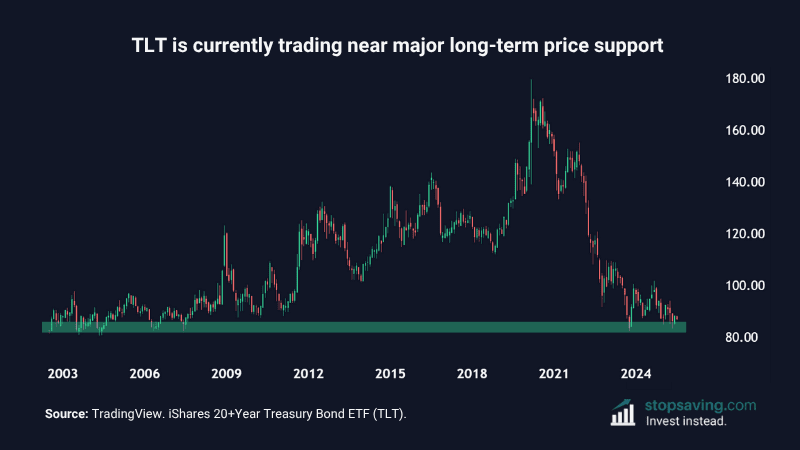
As the chart shows, TLT is trading near major price support from the early 2000s. It’s down about 50% since its blow-off top in March 2020 – during the Covid panic when stocks and crypto tanked.
How UK investors can get exposure to long-dated US Treasury bonds
I currently hold the iShares USD Treasury Bond 20+Year UCITS ETF (Ticker: IBTL) via my UK broker, Hargreaves Lansdown. IBTL trades on the London Stock Exchange – it’s the UK- and EU-regulated version of TLT.
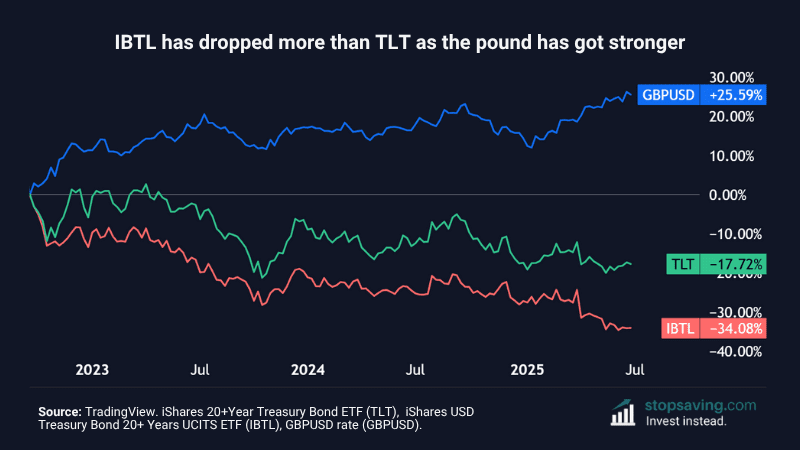
Keep in mind there’s a currency effect. The bonds in IBTL are in US dollars. So if the dollar strengthens, your returns in pounds go up. If it weakens, your returns go down.
That’s why the IBTL chart has dropped more than TLT lately – the dollar has been weaker versus the pound:
The technical trade setup for IBTL
The next chart shows monthly price candles of IBTL – each candle represents one month of price movement. Since we’re using monthly candles, this is a longer-term setup – likely a year or more.
Here’s what I’m watching. At the start of the year, the Bollinger Bands squeezed (green circle), meaning volatility dropped. Now the bands are widening again – a sign that volatility is expanding from a low base. That’s usually when you see a big move in one direction or another.
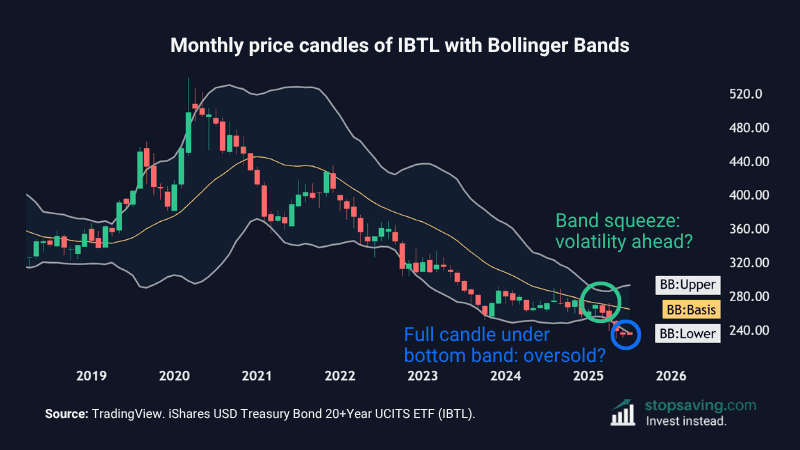
At first glance, the move looks like it’s continuing lower – and so far, that’s true. But look at the blue circle: June’s monthly candle opened and closed entirely below the lower Bollinger Band. That doesn’t happen often – it’s an extreme move that can snap back the other way.
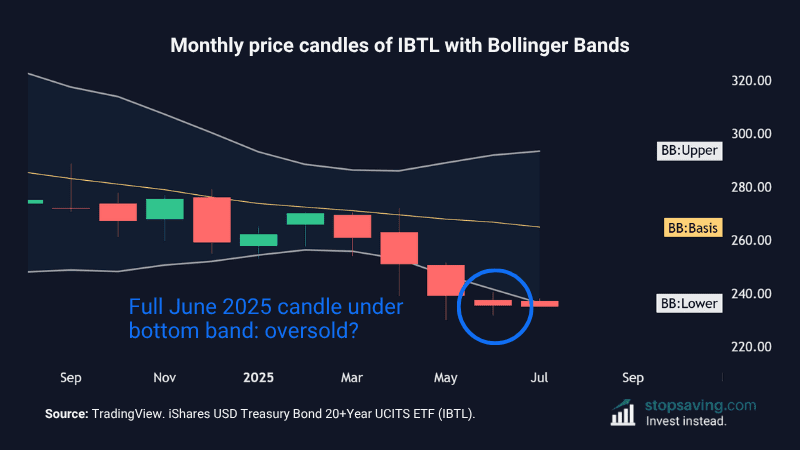
Maybe the pound weakens. Maybe TLT rebounds. Maybe both. Either way, if IBTL closes this month green and back inside the lower band, that would look like a strong macro bottom signal.
To learn more about Bollinger Bands, check out our free PDF guide below:
Key takeaways
- Long-term US Treasury bonds could rise if inflation and interest rates fall, making them attractive in a deflationary setup.
- UK investors can buy IBTL, an ETF on the London Stock Exchange that holds long-dated US Treasury bonds.
- IBTL’s June candle opened and closed below the lower Bollinger Band – a rare move that could signal a macro bottom forming.