The Case for an AI Recession (And How to Invest)

Artificial Intelligence (AI) can make businesses more efficient, but it can also put people out of work. Here’s why AI might cause the next recession, and how to invest if it happens.
How could AI cause a recession?
A recession usually starts when businesses cut back. That can happen for all sorts of reasons – high interest rates, rising costs, or falling product demand. But in the case of AI, there’s another possible trigger: efficiency. AI is helping companies do more with less. That’s great for profit margins, but it could also hurt the job market.
Here’s the (overly simplified) version of how AI might cause a recession:
- People lose jobs (because AI can do them better).
- People spend less money (because they don’t have jobs).
- Businesses sell fewer products and services (because people spend less money).
- Businesses have less money (because they sell fewer products and services), so they cut more jobs.
- See step 1.
Is AI causing people to lose jobs now?
You may sense the job market is getting tougher – with more “open to work” banners on LinkedIn. Nine months ago, graphic designer Courtney Summers even put “desperate” to work on her profile image and then posted about it. The post went viral – with over 400,000 likes – but she still hasn’t taken the banner down.
Yes, this is an extreme example. But AI is getting better at graphic design – and pretty much anything that you can do at your desk. That’s a real threat to the job market.
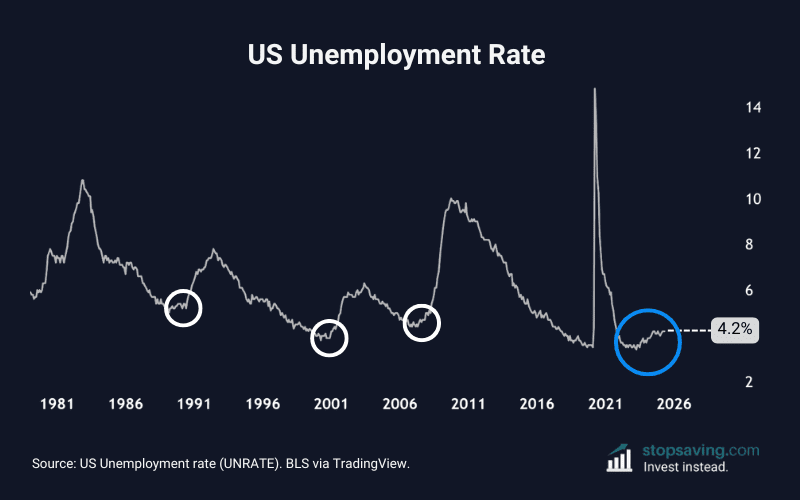
As for the economic data around jobs, it’s a bit of a mixed bag. The “official” US unemployment rate is 4.2%, which is low compared to other times in history. But notice how it’s ticked up gradually over the past two years (blue circle). Whenever that’s happened before (white circles), a bigger spike followed. That could be because of the “job loss spiral effect” (see points 1 to 5 above).
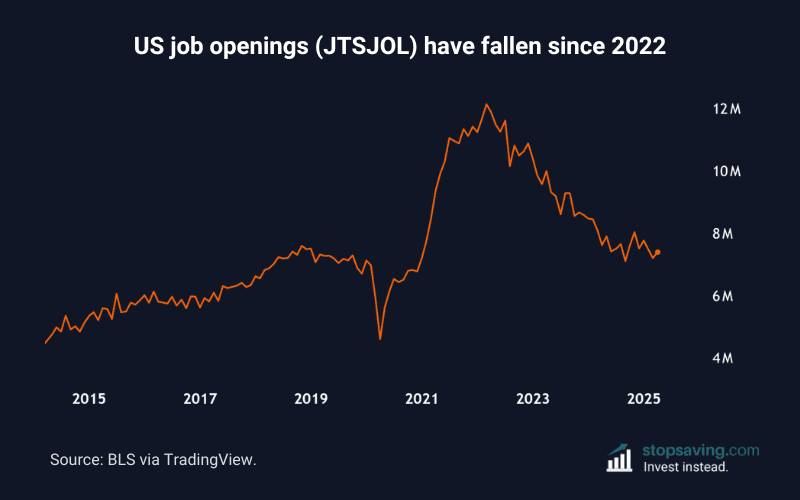
The next chart shows how US job openings (JOLTS) have fallen since 2022. Maybe AI has something to do with this?
How to invest if there’s an AI recession
The bad news is that AI could replace a lot of jobs – and maybe that causes a recession. The good news is that AI makes things cheaper to produce – and that might cause inflation to come down.
In a low employment, low inflation economy, holding long-dated US Treasury bonds could make sense. These bonds are basically loans to the US government, which could give them a “safe-haven” status in a recession.
They also pay investors fixed coupons for 20-plus years. If inflation drops because of AI, those future coupon payments keep more value.
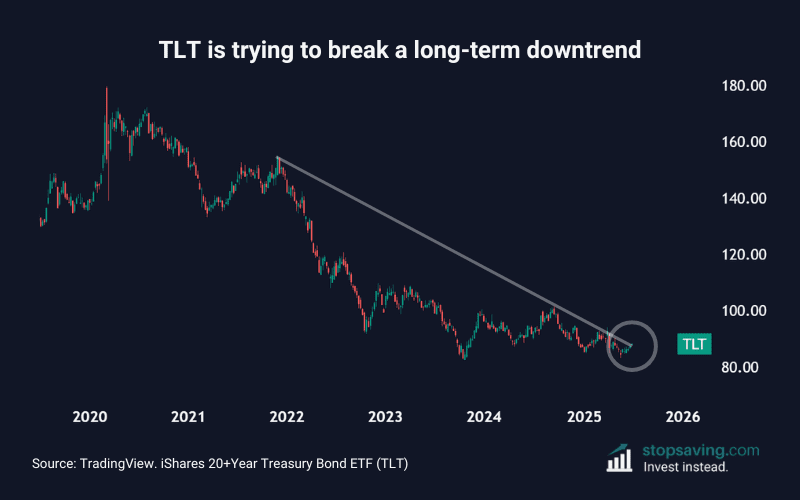
The iShares 20+Year Treasury Bond ETF (TLT) is an exchange-traded fund that holds a basket of US Treasury bonds. TLT is down roughly 50% since March 2020. The chart shows that it’s threatening to break a major downward trendline.
As usual, none of this is investment advice. To learn more about trendline investing, grab our free PDF guide below:
Key takeaways
- AI helps companies cut costs – but that could mean fewer jobs, lower spending, and a possible recession.
- The US job market is already looking weaker, with unemployment creeping higher and job openings falling.
- AI could also cause inflation to come down. In a low employment, low inflation economy, holding long-dated US Treasury bonds could make sense.