ETH/BTC Falling Wedge Breakout: 2 Targets for the Ratio
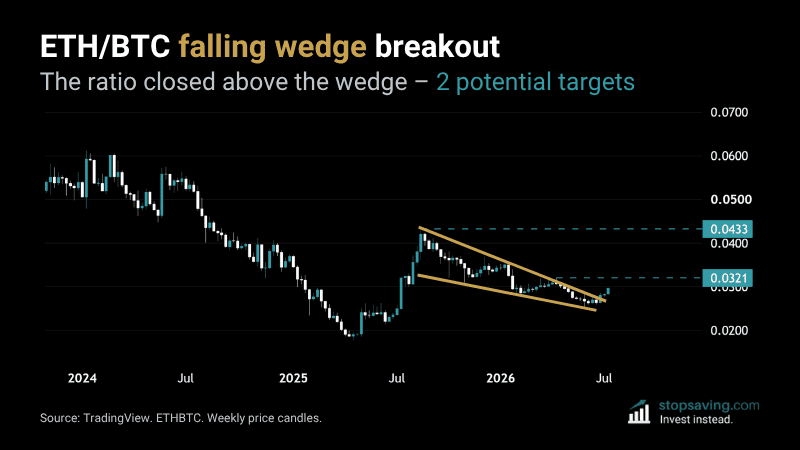
The ETH/BTC ratio measures how much bitcoin one Ethereum is worth. Right now it’s just under 0.03 – meaning one ETH buys you nearly 0.03 BTC. When the ratio rises, Ethereum is beating bitcoin. When it falls, bitcoin is winning. And for the past year, bitcoin was winning inside a pattern called a falling wedge. Last week, that pattern broke – in Ethereum’s favor.
How the ETH/BTC falling wedge broke out
A falling wedge is a kind of compression pattern, where two downward-sloping trendlines squeeze together over time. The top line connects the peaks of each bounce, and the bottom line connects the floors of each drop. Both lines point down – but here’s the key part: they point down at different speeds.
On the weekly chart (ETHBTC, TradingView), the top line falls steeply from the July 2025 peak near 0.044. Every rally got capped at a lower level than the one before. But the bottom line fell less steeply. Sellers kept knocking the ratio back down – yet each time, they did it with less power.
That’s what a falling wedge really shows: sellers still in charge, but getting weaker. Last week, the ratio closed a weekly candle above the top line for the first time. So the ceiling that capped every rally for a year finally gave way.
Two targets for the ETH/BTC ratio
If you go strictly by the technical analysis book, the first target is at around 0.032. That’s where the ratio’s last bounce topped out inside the wedge in April this year. Old peaks like this tend to act as resistance. It’s also the level that would break the downtrend itself. A downtrend is a staircase going down: each bounce peaks lower than the last. Climb above the previous step, and the staircase is broken.
The second target is near 0.043 – where the wedge began. When a falling wedge breaks upward, the standard technical target is a return to the pattern’s starting point.
Regardless of whether this pattern plays out or not, Ethereum looks historically cheap versus bitcoin.
As usual, none of this is investment advice. To learn more about falling wedges and other trading patterns, check out our compression patterns guide.