Safest Investment Over Past 5 Years? (What The Data Says)

Not all investments are created equal – some swing like a rollercoaster, while others barely budge. If you’re wondering what the safest investment was over the past five years, I crunched the numbers for stocks, bonds, gold, and bitcoin. I measured volatility (risk), drawdowns (worst-case scenario losses), total returns, and Sharpe ratios (risk-adjusted performance) using data from PortfolioVisualizer. Here’s how the results stack up.
Safest investment by yearly volatility
Volatility tells us how much an investment moves up and down over time. The more volatile it is, the bigger the price swings. Safe investments should have lower volatility (in theory).
To measure volatility, we can use standard deviation. This tracks how much prices fluctuate on average per year. The lower the standard deviation percentage, the more stable the investment was over from Jan 2020 through Dec 2024.
The chart below compares the volatility of each investment. Note: I used low cost exchange-traded funds (ETFs) for each investment apart from bitcoin:
- Stocks – Vanguard Total World Stock ETF (Ticker: VT)
- Bonds – Vanguard Total World Bond ETF (BNDW)
- Gold – SPDR Gold Shares (GLD)

- Bonds were the least volatile investment at 5.8% – no surprise there.
- Gold and stocks were in the middle, at 14.4% and 17.8%, respectively.
- Bitcoin was the most volatile by a country mile, with 69.0% volatility.
If you wanted the steadiest ride, bonds were your safest bet. But safety has a cost (more on that later).
Safest investment by max drawdown
Volatility is one thing, but what about the worst-case scenario? Max drawdown tells us how much an investment lost from its peak to its lowest point over those five years. Note: these numbers are based on month-to-month returns, which smooths out intra-month highs and lows. Actual worst-case drawdowns were slightly bigger.
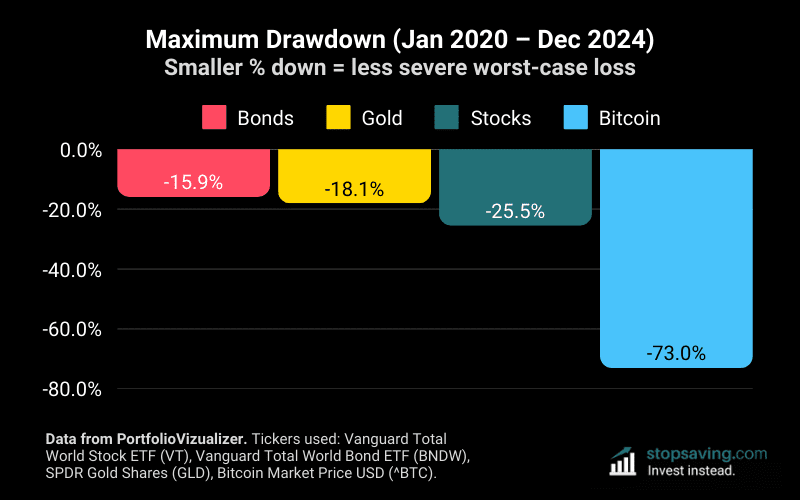
- Bonds again take the crown for stability, with a -15.9% drawdown.
- Gold and stocks were similar, with losses of -18.1% and -25.5%, respectively.
- Bitcoin was down a brutal -73.0% at its worst.
So if avoiding big losses was your main priority, bonds were the safest investment again. But here’s the problem with playing it too safe…
Why safe investments aren’t always good investments
Risk and reward go hand in hand. Investments that barely move tend to lower returns over time. The past five years prove that point. Check the chart:
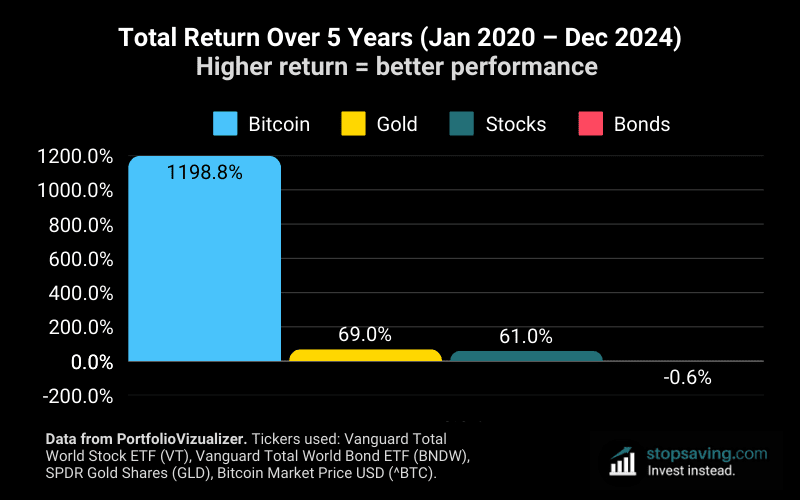
- Bitcoin returned a ridiculous 1,198.8% (despite the 73% drawdown).
- Gold gained 69.4%, slightly outperforming stocks.
- Stocks grew 60.7% – solid, but not eye-watering.
- Bonds returned -0.6%. Not a typo. You lost money.
That’s the trade-off. Low volatility might help you sleep at night, but it doesn’t always help your portfolio grow.
Sharpe Ratio – comparing apples with apples
The Sharpe Ratio measures how much return an investment delivered per unit of risk. This levels the playing field when comparing riskier and safer investments.
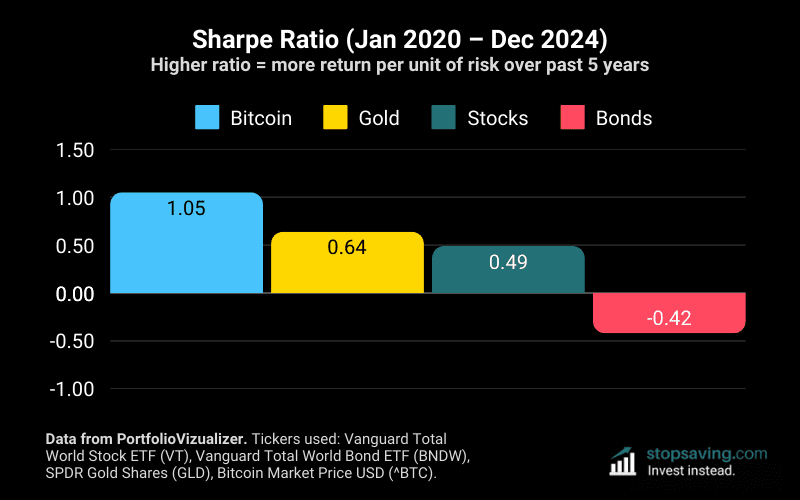
- Bitcoin had the highest Sharpe ratio (1.05) – meaning its massive returns somewhat justified the risk.
- Gold followed with 0.64, offering a solid risk-adjusted return.
- Stocks lagged at 0.49, but still beat bonds.
- Bonds got -0.42. The only asset that had more risk than reward.
If you’re looking for the best investment per unit of risk, bitcoin won this particular battle hands down.
The verdict: what’s the safest investment?
The data shows there’s no single safe investment. Bonds protected capital but lost money. Bitcoin dominated in returns but was a rollercoaster. Gold and stocks found a middle ground. The next five years could look very different – so diversification is key.
Key takeaways
- Bonds were the “safest” investment by volatility and drawdowns from Jan 2020 through Dec 2024 – but they lost money.
- Bitcoin was the riskiest but had the highest returns.
- Gold and stocks balanced risk and return, offering decent stability with positive gains.
As usual, none of this is investment advice. If you liked this piece, check out my free newsletter for how-to guides and investment insights across crypto, stocks, metals, and more.