Hedge Funds Are Short Ethereum – Could It Backfire?
Ethereum has been in the spotlight lately, but not in a good way. Hedge funds are going short Ethereum (ETH) futures on the Chicago Mercantile Exchange (CME) in record amounts. And while that might seem bearish at first, the reality is a bit more complicated.
How CME ether futures work
CME ether futures let traders bet on ETH’s price – without actually owning any ether. Instead of buying or selling real ether (spot), traders use futures contracts that settle in cash. When the contract expires, they just pay or receive the difference between the contract price and ETH’s spot market price. Hedge funds and big investors use these futures for speculation, hedging, and other complex trading strategies.
Why are hedge funds going short Ethereum?
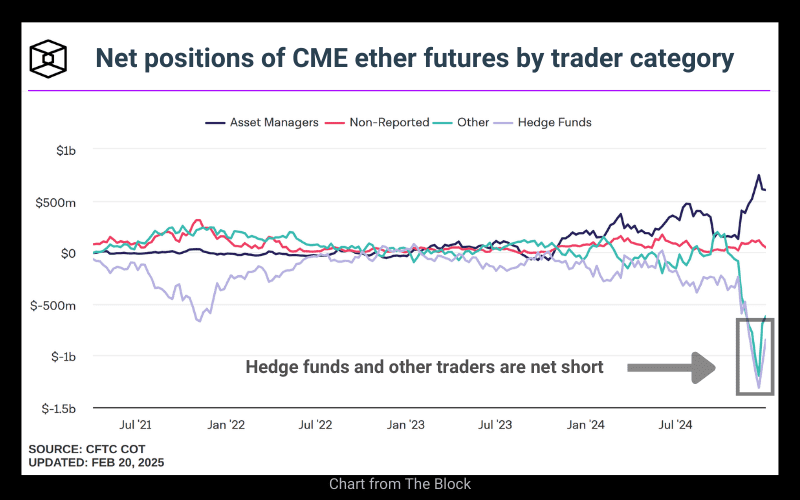
Data from The Block shows that hedge funds’ net short positioning on CME ether futures peaked at -$1.3 billion in December. In January, that number dropped slightly to -$847.1 million – but it’s still historically high. The “other trader” category (which includes proprietary trading firms) is also heavily net short. This category was net short Ethereum -$620.2 million in January, down from a peak of -$1.2 billion in December.
In other words, hedge funds and other traders have been stacking massive short bets against ETH – way more than usual.
The chart below paints an interesting picture. Hedge funds’ (light purple) and other traders’ net short positioning (green) are at extreme levels compared to historical norms. This suggests a specific strategy could be at play – likely the basis trade. Note: This chart updates in real-time, so the numbers may differ depending on when you read this.
The basis trade: how hedge funds profit from shorting Ethereum
Hedge funds love a good basis trade. In this case, they’re going short Ethereum futures (via CME), while simultaneously buying spot ether (via Ethereum ETFs). The basis trade works best when Ethereum futures trade above spot (a condition known as contango).
As each futures contract closes, the futures price and spot price typically move closer together (i.e. the basis shrinks). So the idea of the basis trade is to get in early (when the basis is wider), and then get out when it narrows. That price differential is what hedge funds book as profits.
This setup isn’t necessarily bearish for ETH – it’s more of a structural trade. But if the ETH price starts rising, funds might be forced to unwind their shorts by buying back ether futures. That could set the stage for a potential Ethereum short squeeze.
If you’re not sure how short squeezes work, check out our guide: What Is a Short Squeeze and How to Trade It.
As usual, none of this is investment advice. If you liked this piece, check out my free newsletter for how-to guides and investment insights across crypto, stocks, metals, and more.