What Is a Short Squeeze? How It Works and How to Trade It
Most traders love a bull run, but nothing moves a market quite like a short squeeze. When short sellers get trapped, prices can skyrocket in a chain reaction of forced buying. In this guide, I’ll explain what a short squeeze is and how it works using real-life examples with stocks and crypto. We’ll then wrap things up with how to trade a short-squeeze to your advantage.
Quick primer: what is short selling?
Before we jump into short squeeze mechanics, let’s first understand what short selling is. Unlike investment buyers, short sellers make money if prices drop. Instead of buying low and selling high (like normal investing), short sellers aim to sell high and buy low.
To short an investment (like stocks, crypto, or gold), traders must first borrow it from an exchange or broker. They then sell it at the current price – hoping to buy it back for a lower price later.
If the price drops: Short sellers buy the asset back at a lower price than what they sold it for. They return the asset to the lender, and pocket the price difference as profit.
If the price rises: The trade backfires. Short sellers still owe the asset, but now it’s more expensive to buy back – meaning losses can pile up fast.
And that’s where the short squeeze comes in…
What is a short squeeze?
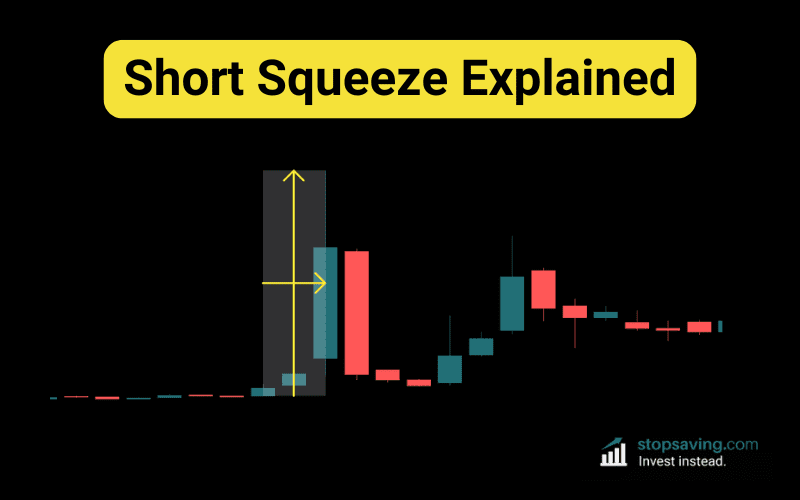
A short squeeze is exactly what it sounds like – when short sellers are “squeezed” out of their trades. When too many traders are short an investment, it’s riskier to go with the herd. Remember, short traders must buy back the asset to close their trades. So if the price spikes higher, it can trigger a wave of buying pressure that drives prices higher very fast.
Here’s how a typical short squeeze plays out, step-by-step:
- Traders pile into short positions, expecting prices to fall.
- Prices unexpectedly move up, trapping shorts in losing trades.
- Short sellers rush to buy back their positions to limit losses.
- The forced buying accelerates the rally, squeezing even more shorts.
The GameStop short squeeze – how retail traders crushed hedge funds
The GameStop short squeeze of 2021 is one of the wildest in stock market history. It showed how retail traders – armed with social media and a common goal – could take down hedge funds and spark a financial frenzy.
Hedge funds heavily shorted GameStop, betting on its decline. At one point, more shares were shorted than even existed – short interest exceeded 100% of total shares. Retail traders on the r/WallStreetBets Reddit group spotted the setup and started buying GME aggressively.
Retail traders also bought call options on GME, forcing market makers to buy GME stock to hedge. As the price rocketed, it forced to short-sellers cover (buy), pushing it even higher. GME stock then jumped 2,440.8% within three weeks (yellow, chart below). Hedge funds like Melvin Capital lost billions, and brokers like Robinhood restricted trading. Eventually, GME crashed back down.

The Tesla short squeeze – betting against Elon didn’t end well
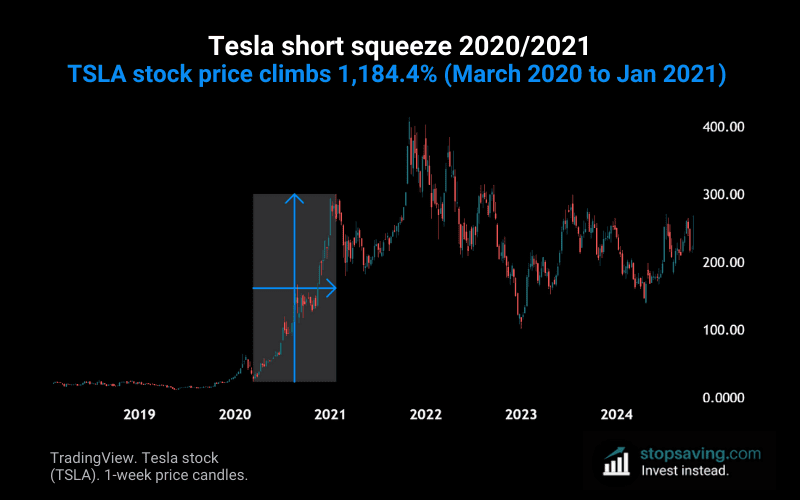
Tesla (TSLA) has had multiple short squeezes, but the biggest one was in 2020. Short sellers piled in, convinced the company was overhyped and overvalued. That year, Tesla was one of the most shorted stocks in the market, with over $20 billion in short positions. But demand for Tesla’s cars kept growing, and Musk’s bold vision had retail investors buying the stock heavily.
Tesla delivered better-than-expected earnings in 2020, forcing shorts to rethink their bets. As the stock climbed higher, more shorts got squeezed out, creating a domino effect of forced buying. To add fuel to the fire, Tesla joined the S&P 500 index in November, triggering even more forced buying from index funds.
As the chart below shows, Tesla stock climbed 1,184.4% from March 2020 to January 2021. The stock then dropped about 50% over the next six months, before carrying on with the rally.
Crypto short squeeze – why shorting bitcoin is risky
Bitcoin has short squeezes all the time – especially in bull markets as the price keeps trending higher. For example, on November 6, 2024, $486.9 million of short bitcoin futures contracts were liquidated across various crypto exchanges. The short liquidations continued in the days after (blue, chart below) as bitcoin rallied from $70,000 to $90,000.
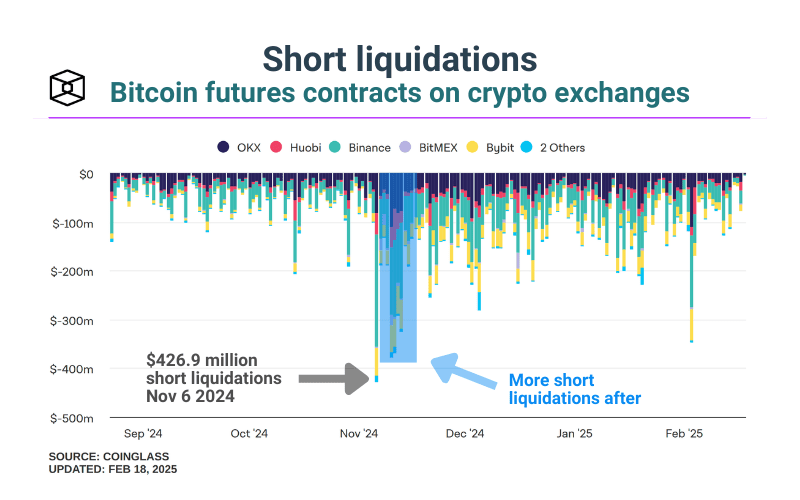
Liquidation happens because traders don’t have enough margin (collateral) to cover their losses. They lose big, as the exchange automatically closes their short positions – by buying back futures at market prices. All that buying pushes prices higher, creating a chain reaction of short liquidations – a classic short squeeze.
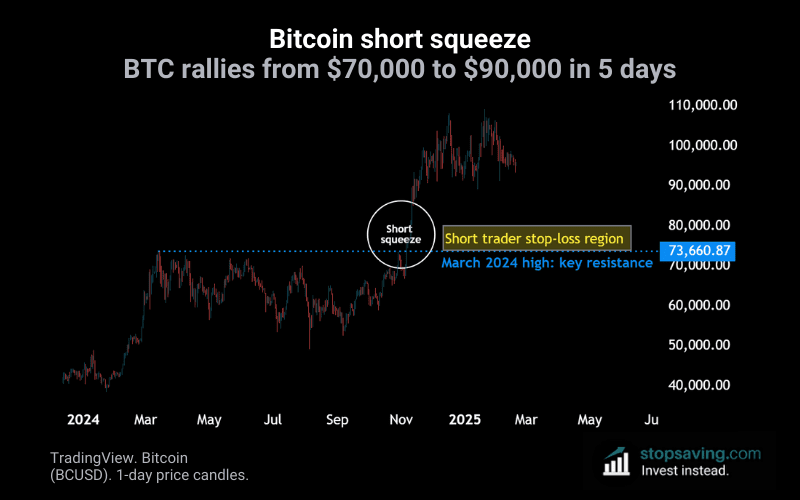
Besides liquidations, bitcoin traders who were short in November 2024 had set their stop-losses near major resistance (blue, chart below). Before that, bitcoin was trading in a sideways range since March. So once that resistance finally started breaking, it stopped out a lot of short traders. At that point, short traders had to buy back those contracts – which increased buying pressure further.
Side note: long traders can get liquidated too. Check out our crypto liquidation heatmap guide to learn more.
How to trade a short squeeze in four steps
Short squeezes move fast, but if you spot the signs early, they can be profitable opportunities. Here’s how to trade them step-by-step:
Step 1 – Find high short interest: If short interest is high, there’s more squeeze potential. Look for stocks with heavy short positions. Sites like MarketWatch and HighShortInterest.com list the most shorted stocks.
For crypto, look for deeply negative funding rates – this means short traders are paying to stay short. Check out our crypto funding rate heatmap guide to learn how that works. Rising futures open interest signals also a general build-up of leverage. If open interest rises while funding rates remain negative, it tends to signal excessive short positioning. You can check open interest on Coinglass or CryptoQuant.
Step 2 – Watch for a breakout above resistance: A sharp price move above key resistance can force shorts to start covering (buying). Download our support and resistance trading PDF guide below to learn how to gauge those levels.
For crypto, you can also spot potential short liquidation levels with the liquidation heatmap (guide here).
Step 3 – Ride the momentum: Once shorts get squeezed, the rally can accelerate fast. If volume spikes and price keeps climbing, the squeeze is on.
Step 4 – Take profits before it reverses: Short squeezes don’t last forever. Once momentum slows, lock in gains – because nobody ever lost money taking a profit.
Key takeaways
- A short squeeze happens when heavily shorted assets rise, forcing short sellers to cover (buy) and push prices higher.
- GameStop and Tesla had historic short squeezes, while bitcoin squeezes often happen due to liquidations.
- Tracking short interest, funding rates, and breakouts can help traders profit – just make sure to time your exit.
As usual, none of this is investment advice. If you liked this piece, check out my free newsletter for how-to guides and investment insights across crypto, stocks, metals, and more.