Is the Dollar (DXY) Forming a Wyckoff Accumulation Low?
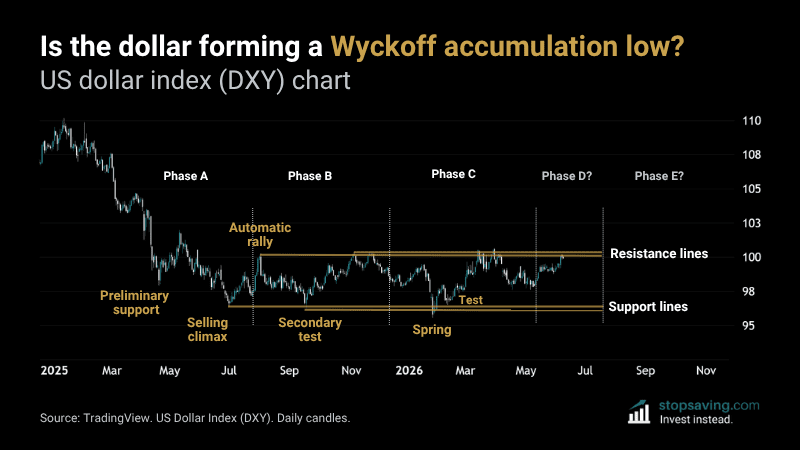
If you’re a fan of the Wyckoff method, you’ll want to pay close attention to this chart. It shows how the US dollar index (DXY, TradingView) has traded in a sideways range for over a year. And the shape of that range looks eerily similar to a Wyckoff accumulation pattern. If the pattern plays out, it would suggest the US dollar could be finding a major low. And it could get a lot stronger versus other currencies in the coming months.
Of course, you can’t buy the dollar index directly, but it tracks the demand for dollars. So Wyckoff’s buyer-vs-seller logic still applies.
Is the US dollar in “Wyckoff phase D” of the accumulation schematic?
Not quite – the dollar looks closer to the end of phase C, with phase D still to prove itself. Here’s how the range reads against the schematic.
In phase A, the slide from the 2025 highs near 110 ran out of sellers. The dollar put in a selling climax near 96, then an automatic rally that set the ceiling around 100. Phase B is the long sideways range that followed – between 96 and 100 – where buyers and sellers fought it out for months. Then came the most convincing piece: the phase C spring. The dollar dipped below support in early 2026 and snapped straight back above it. A failed breakdown like that could’ve flushed out the last sellers.
What confirms the dollar’s Wyckoff bottom?
That brings us to now. The dollar is at the top of the range again, right at the 100 ceiling. To complete phase D, the US dollar index would need to show a sign of strength above 100. In other words, it would need to hover above there for a bit and turn it into support. That’s what Wyckoff traders would need to see before the phase E breakout. By that time, bigger investors would have loaded up on their dollars, and “accumulated” all the selling pressure. According to Wyckoff theory, at least.
The accumulation theory breaks if the DXY loses the spring low near 96. That would turn the spring into a failed bottom and put the whole range at risk.
As usual, none of this is investment advice. To learn more about accumulation and distribution cycles, check out our Wyckoff method guide. You can also read how the DXY index affects other investments.