Nvidia (NVDA) Just Confirmed an RSI Bearish Divergence
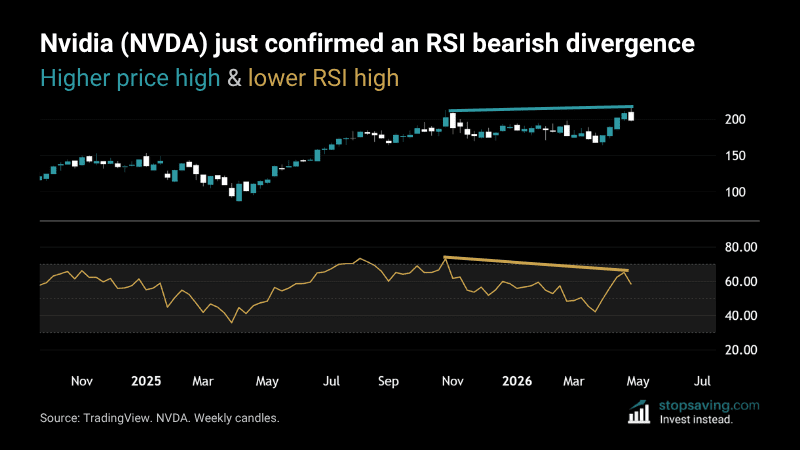
Nvidia’s weekly chart just confirmed a bearish divergence between the price and the relative strength index (RSI). The price made a new high in April 2026 – above its October peak. But the RSI didn’t follow – it made a lower high. If you’re going strictly by the technical analysis book, last week’s bearish engulfing candle was the “confirmation” of that top. And the confirmation of the RSI bearish divergence.
How the bearish divergence works
The relative strength index (RSI) measures the strength of buying pressure versus selling pressure. When the price hits a new high but the RSI doesn’t, that’s a bearish divergence. It’s a sign buying pressure is fading even as the price climbs.
That’s exactly what’s happened on Nvidia’s weekly chart. A higher price, but weaker momentum, according to the indicator. Buyers got Nvidia up there, but they had to work harder to do it.
For RSI bearish divergence to “activate”, you need “confirmation” of a recent high. If there’s no high, there can be no bearish divergence. Last week’s bearish engulfing candle was that confirmation. It pushed above the prior week’s high during the week, then closed below the prior week’s open. That’s a technical reversal signal: it shows sellers made a strong comeback to win the week.
Trade the chart, not the earnings
Nvidia reports its quarterly earnings results on 20 May 2026. Analysts expect the company to make about $1.78 in profit per share (EPS), on $78 billion in revenue. Nvidia’s actual results have been better than analysts expected for 8 quarters in a row. So don’t be surprised if they’re better again this time.
But a good earnings report doesn’t always mean the price goes higher. Sometimes investors “sell the news” even when the results are good – especially when the chart looks a bit bearish.
Nvidia is also around 8% of the S&P 500 – the heaviest single-stock weighting in the index. If the bearish divergence plays out, the index could feel it too.
As usual, none of this is investment advice. I can be wrong, just like everyone else. To learn more about RSI divergences, check out our RSI Explained guide.