MicroStrategy (MSTR) Rejects at the 200-Week Moving Average
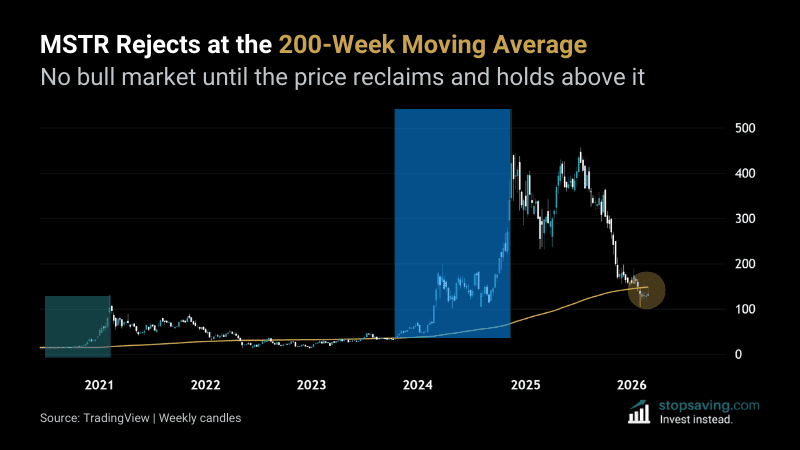
MicroStrategy stock (MSTR) hit its 200-week moving average from below last week – and got slapped back down. The stock’s down about 75% from its all-time high of $543 in November 2024. No bitcoin-era bull run for MSTR has ever started without it first reclaiming – and holding – the 200-week MA.
What the MSTR 200-week MA has told us so far
The 200-week moving average smooths out years of price action into a single line. For MSTR, it’s been the starting gun for the past two bull runs.
The first bitcoin-era bull run (green) kicked off after MSTR reclaimed the 200-week MA in September 2020. That was about a month after Michael Saylor’s first bitcoin buy for MicroStrategy (now Strategy). The stock ripped higher, peaked in February 2021, then bled all the way back down to the 200-week MA. It then spent about a year building a base around it before the next bull phase.
The second bull run (blue) started the same way. MSTR reclaimed the 200-week MA in October 2023 after a few failed attempts. It ripped higher, peaked in March 2024, and then bled back down to the MA again.
MicroStrategy holds over 720,000 bitcoin – roughly 3.4% of all the coins that will ever exist. The stock doesn’t always move with bitcoin, but the bitcoin price definitely helps.
Buying near the 200-week MA has been a solid long-term strategy
The stock tried to poke above the MA last week – and sellers just rejected it. That said, the 200-week MA area has been a good accumulation area for MSTR in the past. The best entries didn’t come when the stock was flying above the line. They came when it was building a base around it – which is what could be happening now.
Keep in mind: a reclaim isn’t just one weekly close above the moving average. What you want to see is a close above it, followed by a retest from above that holds as support. Until that happens, no bull run for MicroStrategy.
But if you believe in bitcoin and MicroStrategy long-term, this might be a time to dollar-cost average.
As usual, none of this is investment advice. To learn more about how moving averages work, check out our Moving Averages Explained guide.