


Are you struggling to match your trading strategy with the best trading time frame? This guide is here to help. We’ll start by exploring the three main trading time frames: short-term, medium-term, and long-term. We’ll then weigh the pros and cons of four trading strategies: day trading, swing trading, range trading, and trend trading. By the end, you’ll understand which trading time frame and strategy might work best for you. You’ll also find a video version of this guide at the bottom of this page if you prefer. Let’s jump in.
Video version of this trading time frame guide
PDF download for this trading time frame guide
You can also download the PDF slide deck version of this guide below. This can be used to summarize the main concepts of the guide.
Three main trading time frames: Short-term, medium-term, and long-term
The table below shows three major candlestick time frames that most traders use. It also shows which candlestick charts traders might use for each time frame.
| Trading time frame | Candlesticks typically used | Time in trade |
|---|---|---|
| Short-term (day trading) | 4-hr, 12-hr, or 1-day | Less than 24 hours |
| Medium-term (swing trading and range trading) | Daily, weekly, or monthly | Days to weeks |
| Long-term (trend trading) | Daily, weekly, or monthly | Months to years |
Short-term traders: Day traders typically use 15-minute to 1-hour price candlestick charts to monitor short-term price movements closely. They exit their trades before bed at night, hence the name “day traders.”
Medium-term traders: These usually fall into two camps – swing traders or range traders. Swing traders will look to profit from price moves (up or down) when the market is trending in a clear direction. Range traders, meanwhile, will look to earn profits when the market is ranging sideways between precise levels of support and resistance. Medium-term traders usually trade based on 4-hour, 12-hour, or 1-day price candlesticks. And they can stay in their trades for a few days to several weeks,
Long-term traders: Also known as trend traders or, sometimes, “investors.” These traders rely on daily, weekly, or even monthly price candlesticks for a long-term view of the market’s trend. They’ll usually maintain positions for several months to even years, essentially for as long as the trend is their friend.
Short-term trading time frame (day trading) pros & cons
I’ve tried short-term day trading before. But I got better results when switching to longer-term trading (more on that later). Still, there could be a few reasons why day trading might be best for you.
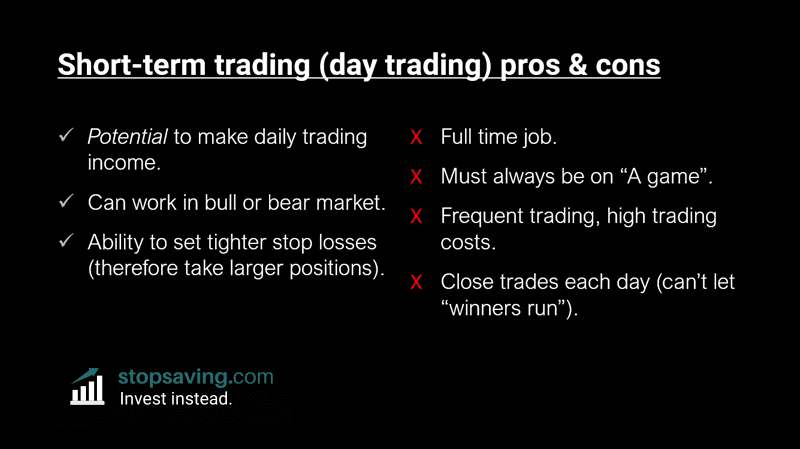
Day trading advantages:
Daily income: There is the potential to earn daily trading income. However, this is only a potential, as being a consistently profitable day trader takes time, practice, and discipline.
Flexibility: Day trading can work in a bull or bear market. You can make money regardless of the general long-term trend of an investment. All you need is daily price movement (up or down).
Trade size: You can take bigger positions with day trading. Prices generally move less in a day than in a week or month, so you can set your stop-loss closer to your trade entry price when day trading.
Day trading disadvantages:
Time: Day trading is a full-time job. You can only be a successful day trader if you don’t have other work commitments.
Risk of burnout: Day traders must always be on their “A game.” Trading can get tiring, and trading when tired can lead to expensive mistakes.
High trading costs: Of course, this will depend on the broker or exchange you use. But other things being equal, the more you trade, the more trading fees you’ll pay. Those fees can seriously eat away at your profits.
Smaller wins: Day traders don’t “let their winners run.” For many successful traders, a few big wins make up for the small losses. So without those big wins once in a while, you’ve got to have a super high win rate on your trades to stay profitable.
Medium-term trading time frame (swing trading) pros & cons
Swing trading involves holding positions for several days to weeks. Here, traders will try to earn profits in a market trending in one direction (up or down).
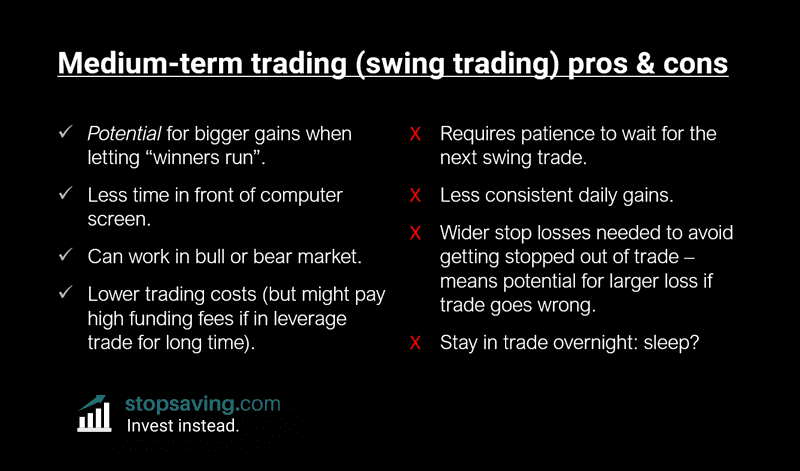
Swing trading advantages:
Bigger wins: Swing traders can let their winners run. Unlike day traders, swing traders don’t necessarily have pre-set profit targets. Instead, they’ll usually stay in a trade for as long as it’s working for them. So, their big wins can make up for small losses.
Time: There’s no need to stare at price charts all day. Since swing traders stay in trades for longer than day traders, they don’t need to monitor as much short-term price movement. That means you can have more time for other commitments and suffer less from trading burnout.
Lower fees: Since you’re trading less often, you’ll generally pay lower trading costs. But if you’re swing trading with leverage, you might pay high funding rates to maintain your position.
Swing trading disadvantages:
Requires patience: You’ve got to be patient as a swing trader. You won’t get trading opportunities as often as you do with short-term trading. So, there can be a lot of waiting around in between trades.
Less consistent income: Swing trading won’t produce consistent daily gains. But, a good swing trading strategy could help you generate consistent monthly or quarterly profits.
Bigger loss potential: There is a potential for bigger losses with swing trading. The price generally moves more over a few days or weeks than a few hours, so swing traders should set their stop-losses further from their entry prices than day traders. That means there’s the potential for bigger losses if the market goes against you. You’ll need to balance those losses out with bigger wins.
Sleep: Swing traders might struggle to sleep at night if they’re still in a trade. I would say two things here: 1) use a stop-loss, and 2) don’t use too much leverage.
Medium-term trading time frame (range trading) pros & cons
Range traders will look to earn profits when the market ranges sideways between clear levels of support and resistance. They’ll usually stay in a trade until the price reaches the top or bottom of a trading range. That can take days or weeks, depending on the size of the trading range and the volatility of the investment.
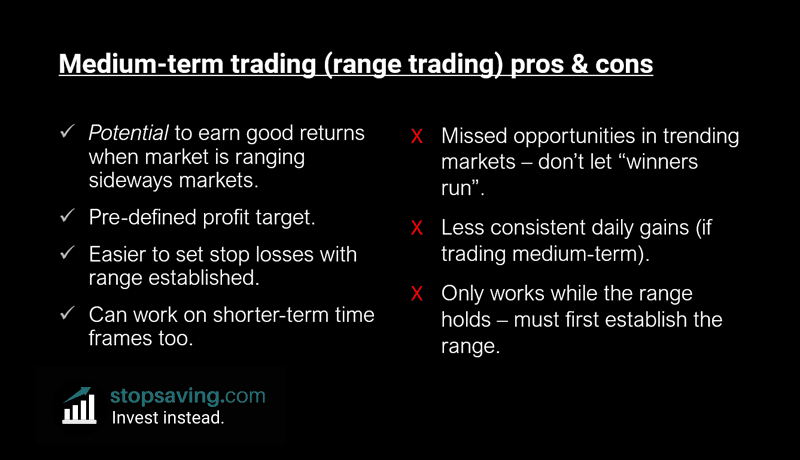
Range trading advantages:
Sideways markets: The market doesn’t need to be in a clear trend. Range traders can still make money when the market is going sideways. And markets tend to go sideways a lot.
Pre-set profit targets: Unlike swing traders, who wait until the trend has ended to take profits, range traders can set their profit-taking levels in advance (at the top or bottom of a trading range). That can make it easier to manage a range trade than a swing trade. And, more often than not, the price tends to stall at the top or bottom of a trading range.
Easier risk management: Range traders can set their stop-losses closer to their entry prices. Because they trade within a well-defined trading range, they have clear conditions for when to exit a trade – i.e., if the price breaks the range.
Range trading disadvantages:
Smaller wins: Range traders don’t let their winners run. Unlike swing traders, they can miss out if the price breaks the range and has a bigger trending move.
Inconsistent profits: Range traders won’t make daily gains. Like swing traders, they typically use medium-term trading time frames. That said, they can also trade smaller ranges within each trading day.
Only works in ranging markets: Range trading only works when the trading range holds. Trading ranges hold until they don’t, and that’s when range trading can be frustrating. You’re better off swing trading or trend trading (covered next).

Long-term trading time frame (trend trading) pros & cons
You might know the saying: “The trend is your friend until the end.” That’s the philosophy of long-term trend traders. They’ll hold positions for months or even years – so long as the macro trend persists. You can also think of trend traders as swing traders over longer trading time frames.
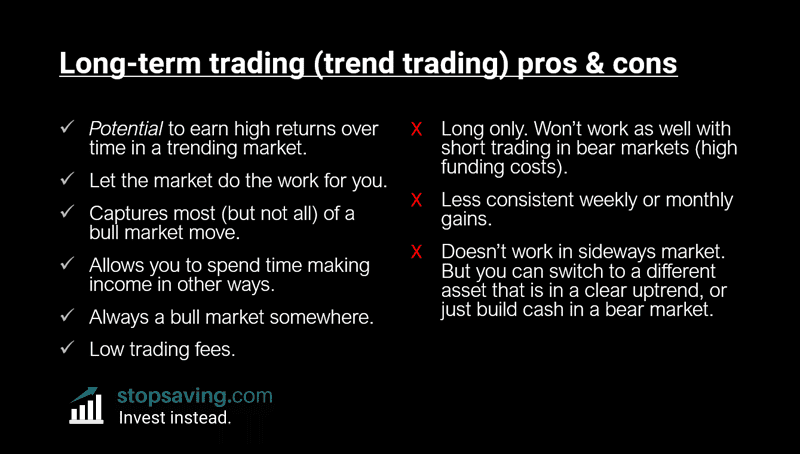
Trend trading advantages:
Less effort: Since you’re only focused on a long-term trading time frame, you can let the market do most of the work. That can give you more time to make money in other ways (like your job or business).
Biggest wins: Trend traders can earn big returns in a strong bull market. As a trend trader, you can capture most of the upside of an entire bull market. And bull markets can last a long time. For example, you might have stayed in bitcoin or Tesla long enough to reap big rewards.
Flexibility: There’s always a bull market somewhere. For example, the US dollar index might be in a bull market while crypto is in a bear market, and vice versa.
Low fees: Trend traders pay the lowest trading fees. Trend traders hardly buy or sell. So, your trading costs are minimal (assuming you don’t use leverage and pay funding costs to stay in your trade). Lower trading fees can save you a lot of money over time.
Trend trading disadvantages:
Bear markets: Trend trading doesn’t work so well in bear markets. You must use leverage (borrowed money) to go short. That means you could be paying high funding costs to stay in your trade for such a long time. So if you are going to trend trade, stick with “spot” buying and selling (i.e., buying and selling the asset with no leverage).
Long-term profit only: You won’t get consistent short-term profits with trend trading. Trend traders won’t make money every week or month. They typically make most of their money during the big moves—and these only happen occasionally.
Sideways markets: Trend trading doesn’t work in a sideways market. When markets are going sideways, range trading is the better approach.
How to choose the best trading time frame for you
Start by assessing your goals and circumstances. Short-term day trading might be a good fit if you’re after consistent daily profits and have plenty of time to spare. If you’re looking to build wealth and have a busy schedule, a longer-term trading time frame is more your style.
Remember, there’s no one-size-fits-all approach to trading. The best trading time frame is the one that suits you and helps you achieve your goals. So, take your time to explore different time frames and strategies. Try them out on demo trading accounts where you aren’t risking any real money. Most importantly, you should be willing to adapt and change your trading style as your circumstances change.
Enjoyed this guide? Sign up for our free newsletter for more of them. And get my free welcome eBook about trading when you do.
This guide is part of our 100% free trading and technical analysis course. Check out the next guide on how to use trendlines for your trading strategy!
Key takeaways
- You can choose between several trading time frames: short-term (day trading), medium-term (swing trading or range trading), or long-term (trend trading/investing).
- Find a trading time frame that suits your goals and circumstances. Note that long-term trading (daily, weekly, and monthly candles) is best for most people.
- Whatever your trading time frame, analyze price charts using the relevant candlesticks.