

Chapter One: Bitcoin Is Scarce
“Bitcoin has no top because fiat [regular money] has no bottom” – Max Keiser
Albert Einstein (supposedly) said: “Compound interest is the eighth wonder of the world. He who understands it, earns it; he who doesn’t, pays it.” The basic idea is that many years of profit can stack up on top of each other and grow your wealth over time. With compounding, your investments gather momentum like a snowball rolling down a hill.
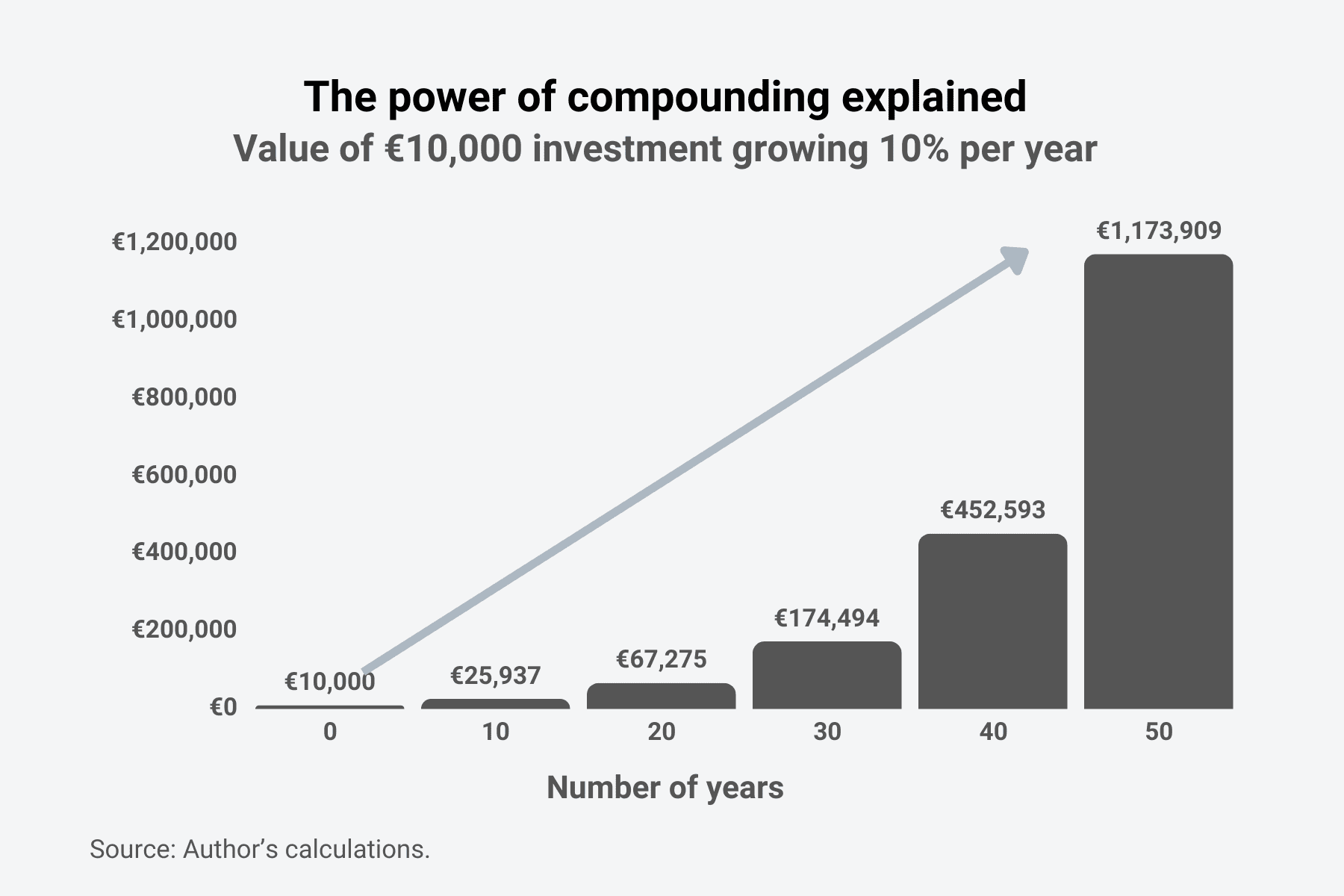
Here’s a simple example to explain the power of compounding. Let’s say you invest €10,000, and it earns you a 10% profit (or €1,000) for 30 years in a row. If you took that profit out of your investment each year for 30 years, you’d have €30,000 in profit. So, your total wealth from investing €10,000 would be €40,000 after 30 years—or four times what you put in.
But if you compounded that 10% growth each year, you’d keep the profits in your investment and let them grow at 10% per year. That’s when the snowball analogy kicks in: after 30 years, you’d be sitting on €174,494—nearly 18 times your initial investment.
In time, your investment would grow exponentially because of compounding. After 40 years, it would be €452,593. After 50 years, you’d be a millionaire—with €1,173,909 to your name.
This is only a hypothetical example, of course. But as Einstein’s quote suggests, compounding works both ways. Just as compound interest can bring you wealth, compound inflation can take it away.
As the next chart shows, a single euro in 1999 would cost around €1.85 today. That means, on average, the euro has lost about 2.5% of its value each year since its creation.

That may not sound like much each year, but over many years, it adds up. Now, everything is 85% more expensive than it was in 1999. Your euros have compounded—but not in a good way.
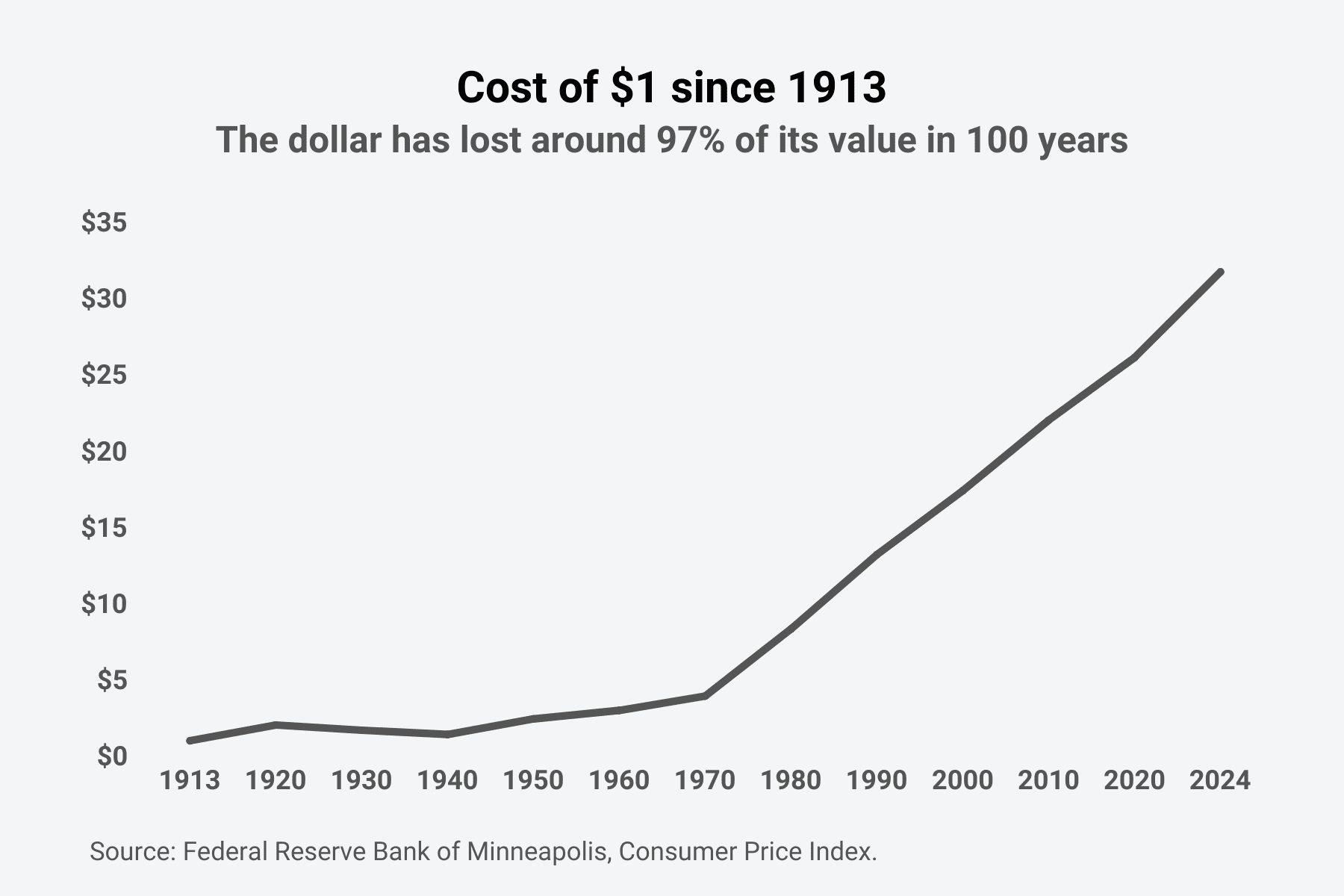
It’s the same problem for every traditional currency—even the mighty US dollar, the currency of the world’s biggest economy. One dollar in 1913 would cost you nearly $32 today.
The dollar has lost just over 3% per year (on average) over the past century. But thanks to the power of “reverse compounding,” it’s now 97% less valuable.
Bottom line: saving cash in your bank account will not make you wealthy in the long run. In fact, you’re getting poorer each year by saving.
The Taylor Swift concert ticket analogy
Jack Mallers is well-known for his unshakeable belief in bitcoin. During a 2024 interview with Kitco News, he explained the current financial system with a simple analogy:
Imagine you owe someone 20 Taylor Swift concert tickets. For most people, you have two options:
- Return the tickets in full.
- Admit you can’t pay and default on your debt.
But if you were a government, there’s a third option: lower the value of the tickets. Instead of paying back what you owe, you just print more tickets—and make each ticket worth less.
Taylor Swift tickets aren’t cheap—they sold for over $1,000 a pop in some American cities for her 2024 tour. But what if you could make each ticket worth $500 or even $100? Suddenly, paying back your debt gets much easier.
And that’s exactly what governments and central banks do with your money.
Why we have inflation
Christine Lagarde is the President of the European Central Bank (ECB). Her job is to control inflation in the 20 countries that use the euro. But, like all things in life, that’s much easier said than done.
In October 2022, inflation in Europe hit 10.6%. That means Europeans had to pay 10.6% more for the same standard of living than a year before. It was the highest inflation rate since the euro was created in 1999, and Europeans still feel the pinch. Rising grocery, fuel, and electricity costs are squeezing everyone’s budgets.
Lagarde tried to fix the inflation crisis. Her solution was to tighten monetary policy—basically, to slow down Europe’s economy to keep inflation from spiraling out of control.
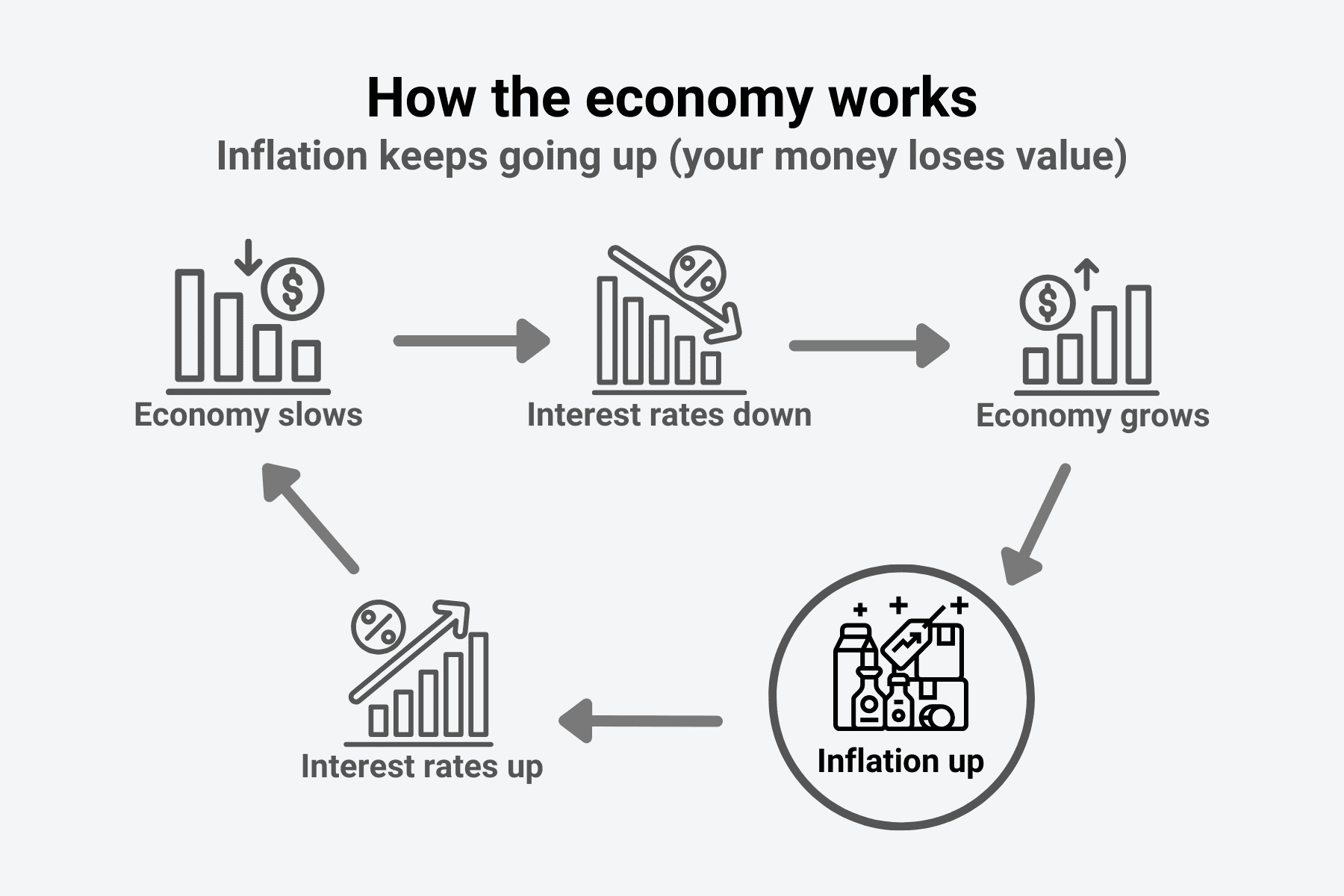
Here’s how it works: to slow inflation, the ECB raises interest rates (the cost of borrowing money). Now, it’s more expensive for people and businesses to take out loans, which cools down the economy. In a slower economy, people spend less money, so prices stop rising as fast (in theory).
But a slower economy also means more people lose jobs and struggle to pay their bills. Unfortunately, that’s the price of keeping inflation down.
So what happens when the economy is struggling? Then, the ECB lowers interest rates. When borrowing money becomes cheaper, the economy picks up again. But there’s a downside: inflation usually comes roaring back, too.
The next diagram sums up the process.
Side note: I’ve used the European Central Bank (ECB) as an example to show how interest rates impact the economy and inflation. But central banks everywhere—like the US Federal Reserve, Bank of England, or Bank of Japan—all use the same playbook.
How (and why) central banks “print” money
We’ve talked about how the ECB lowers interest rates to jump-start the economy. But sometimes, that’s not enough. So, central banks take things a step further by “printing” money—though in today’s world, this process is mostly digital.
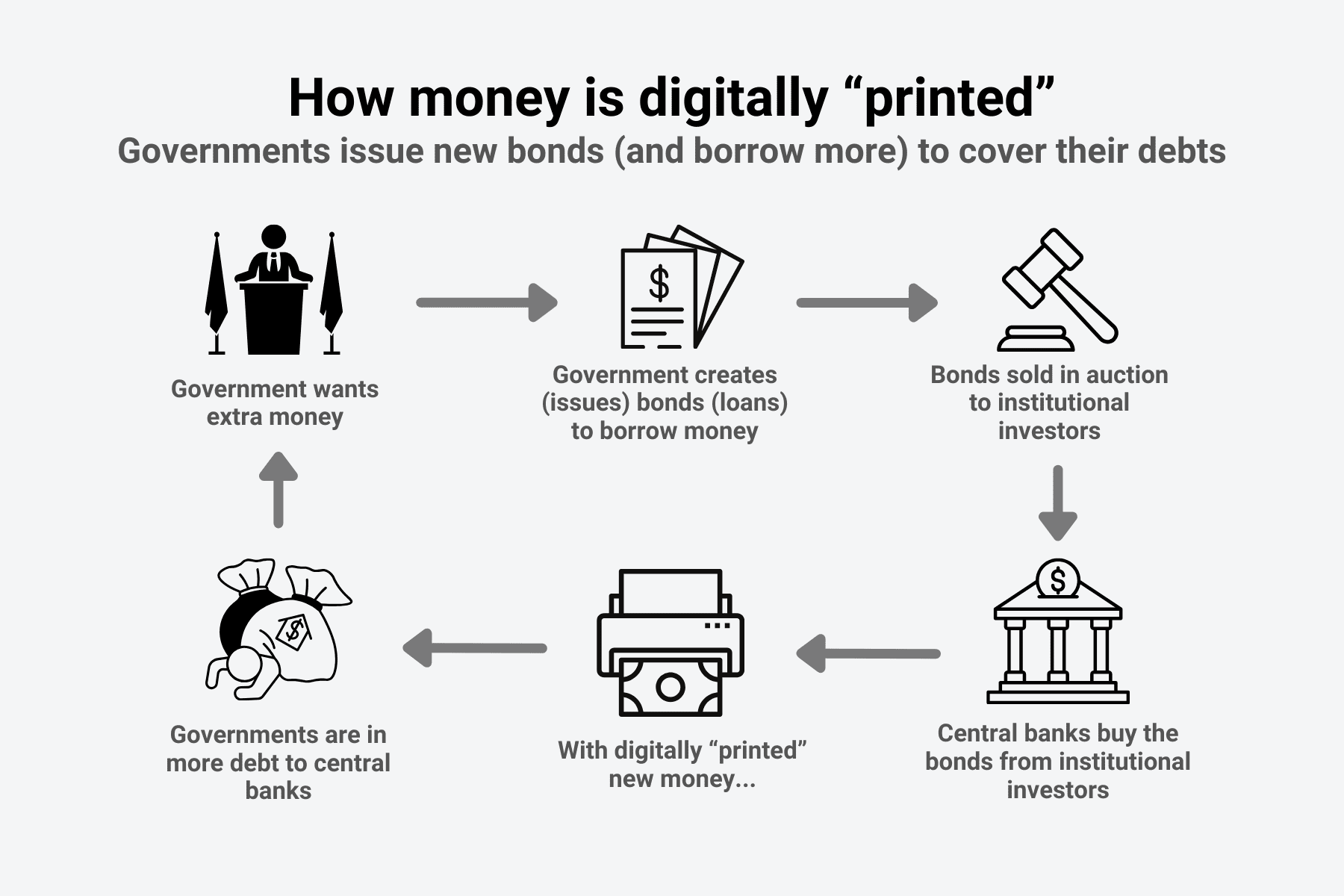
The money printing process starts with government bonds. These are loans that let the government borrow money. If you buy a government bond, the government technically owes you money, plus any interest that might go with it. And if you sell that government bond to someone else, the government owes them that money instead.
Now, let’s say your government needs cash to build a bridge. It can either raise your taxes or borrow the money by issuing (creating) new bonds. Since most voters don’t like higher taxes, governments usually go with the latter option.
First, the government auctions bonds to big banks and financial institutions, who are happy to lend money for a financial payoff in the future. They could earn interest on the loans or potentially sell them to other investors for a higher price.
Next, the central bank swoops in to buy those government bonds from the institutions. The central bank is like the government’s rich uncle who never runs out of money. It can digitally “print” money whenever it likes, and it’s always there as a lender of last resort.
So in a round about way, the central bank lends money to the government. But it doesn’t really expect to be paid back in full. Instead, the government keeps issuing (creating) new bonds to cover the old ones. This kicks its “debt can” further down the road.
All that extra money the central bank prints then goes into the banking system. Banks lend it out and the money printing flywheel grows. Then, a few months or years later, your groceries are more expensive.
Just like those Taylor Swift concert tickets, money printing also helps governments manage their debt—and these days, they’re in an awful lot of it.
The next time you browse the web, search for the “World Debt Clock”. You’ll find a page showing the national debt of the world’s biggest economies. The numbers update in real time, and they grow exponentially.
So unless governments rein in their spending habits, they’ll have to keep printing money to dilute the value of their debt—even if they never pay it back.
How (and why) miners create bitcoin
When I first learned about bitcoin in the summer of 2017, I thought it was incredibly complicated. But after a few weeks of research, it started to make sense. In fact, I found it easier to understand than traditional currencies.
You just learned how central banks create money by buying government bonds. But that’s just the tip of the iceberg—underneath it lies a maze of interest rates, fractional reserve banking, and constantly shifting policies. The deeper you dig, the more your brain freezes.
But creating new bitcoins is much simpler—miners use computer software to mine them.
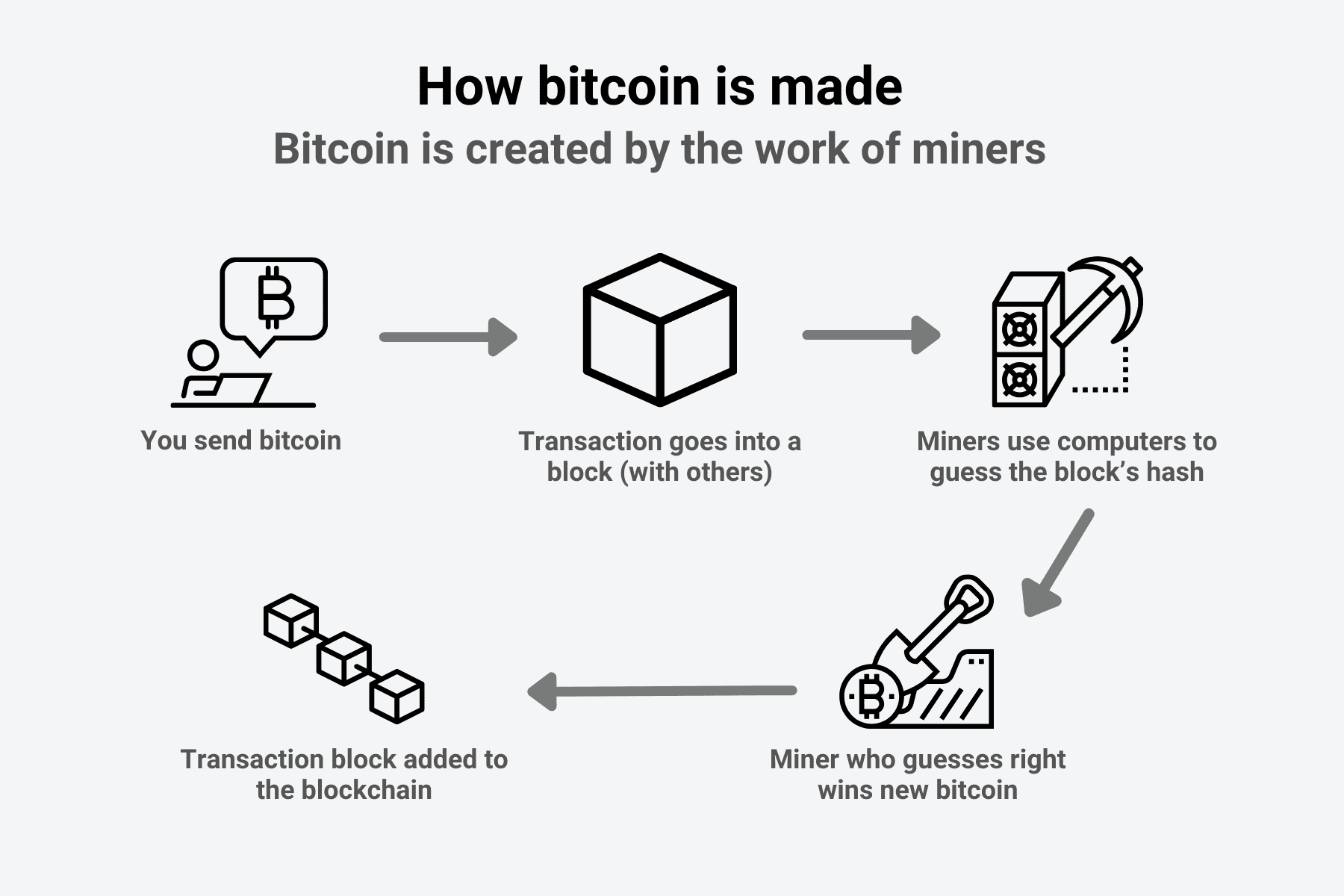
Here’s how it works: miners run computations to guess a specific number called a hash. Each time someone sends bitcoin from one wallet to another, that transaction is grouped into a block with a few thousand others. Every ten minutes (on average), miners race to guess the hash of the new block.
The first miner to guess the hash earns brand new bitcoins as a reward—and adds the block of transactions to the blockchain.
As miners add more blocks, they create a “chain of blocks” (hence the word blockchain). Instead of having multiple records stored across banks and financial firms, there’s just one record—visible to anyone, anywhere, any time.
This public record (the blockchain) contains every bitcoin transaction ever made.
How to capitalize the word “bitcoin”: In this book, you might notice that “bitcoin” is sometimes written with a lowercase “b” and other times with an uppercase “B.” Bitcoin with a big “B” refers to the Bitcoin blockchain or network, while Bitcoin with a small “b” refers to the digital currency itself.
Bitcoin is scarce
In 2008, an unknown person(s) named Satoshi Nakamoto invented a digital currency called bitcoin. Unlike euros or dollars, bitcoin can’t be printed at will.
Bitcoin is mathematically programmed to have a maximum supply of 21 million coins, each divisible into 100 million satoshis (or sats). Every four years, there’s a “halving event,” where the speed of new bitcoin created by miners is chopped in half.
The chart below shows how the coin supply of bitcoin is still increasing, but it’s increasing at a slower speed with each four-year halving event. Technically, there will be no more coins left to mine by the year 2140.
But as the chart shows, bitcoin is already scarce: nearly 20 million have been produced by miners so far—just over 95% of the total coin supply.

Traditional currencies, meanwhile, seem to be doing the opposite. For example, the next chart shows the supply of US dollars. It’s been increasing more and more with time (as with euros, pounds, yen, etc.).
Call me a cynic, but I don’t think 95% of all the currency in the world has already been printed.
Owning bitcoin won’t make you a millionaire overnight—but it’s much scarcer than traditional currencies. So in the long run, it’s better than saving cash in your bank account.
We’ll unpack how bitcoin works some more in the coming chapters—along with nine more reasons to keep stacking sats.
✍️ Key takeaways
- Inflation compounds over time. Your cash becomes less valuable each year.
- Governments handle debt by devaluing currency. They print more Taylor Swift tickets to settle what they owe.
- Central banking is hard. Raising interest rates cools inflation but slows down the economy. Lowering interest rates boosts the economy but speeds up inflation.
- Bitcoin is finite. There will only ever be 21 million coins and about 94% have already been created by miners. Bitcoin is scarcer (and hence more valuable) than any traditional currency.